

Last updated: June 2026
Workday and SAP partner with external workforce management vendors for complex scheduling because scheduling sits in a separate system category from HR and payroll. The suites build the systems of record. The operational middle, where rotations, union rules, and demand-driven rosters live, is specialized enough that both companies run certification programs and marketplaces for outside WFM platforms instead of building that depth in-suite. As of 2026, WorkAxle is listed on both the Workday Marketplace and the SAP Store.
That is the answer to a question many IT leaders are quietly asking this June at SHRM26. You standardized on Workday or SAP for good reasons, and the platform does that job well. Then your operations team shows up with rotating crews across three union agreements, demand that moves by the hour, and a roster that has to rebuild itself when a contract changes mid-cycle. The native scheduling module starts to strain, and the instinct is to wonder whether you chose wrong. You did not. You hit a category boundary.
In this post:
Why do Workday and SAP partner out complex scheduling?
Workday and SAP partner out complex scheduling because every large enterprise runs three distinct systems, and the suites deliberately build two of them. There is HR for hiring, profiles, and performance. There is payroll for paying people. In the middle sits workforce management: scheduling, time capture, and the compliance work that turns a plan into a compliant paycheck.
Oracle, SAP, and Workday build the first and the third. The middle one is too specialized for them to build deep, so they partner for it. If you imagine the stack as a burger, HR and payroll are the buns, and workforce management is the meat. The buns hold everything together, but the part you came for sits in between.
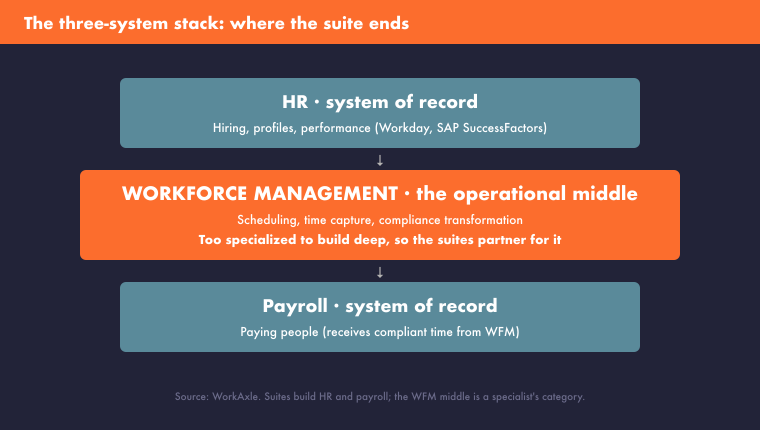
The market's history shows the pattern plainly. For years the complex middle belonged to independent specialists like Kronos and WorkForce Software. Then Kronos merged into UKG in 2020, and ADP acquired WorkForce Software in October 2024. Each specialist got pulled toward the bookends and became a full suite, which is exactly why enterprises keep reaching for a dedicated one.
See the architecture for yourself: how WorkAxle sits between your HR and payroll systems →
What counts as complex scheduling?
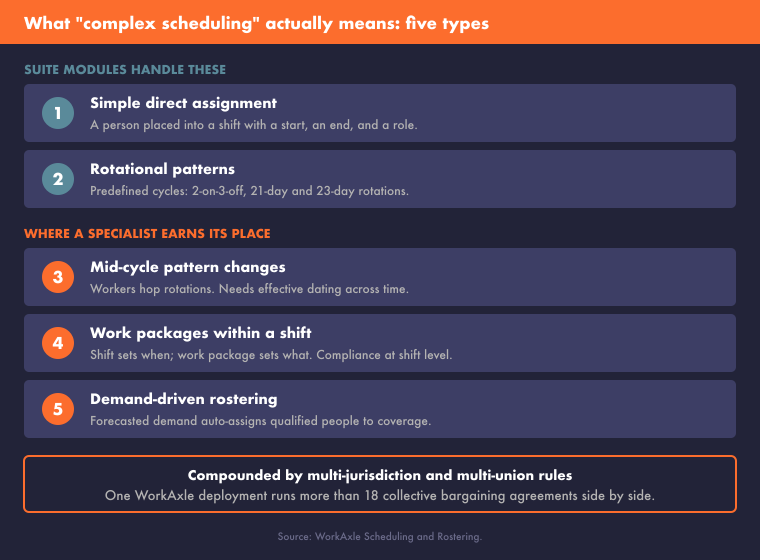
Complex scheduling refers to five distinct ways a schedule can operate, and difficulty climbs with each one. Generic suite modules handle the first two well. The last three are where a specialist earns its place, because they require an engine that reconstructs rules across time, groups, and tasks rather than just dropping names into slots.
The five types are straightforward to name:
- Simple direct assignment. Names down the side, dates across the top, a person placed into a shift with a start time, an end time, and a role.
- Rotational patterns. Predefined cycles that run two days on and three off, or stretch across 21-day and 23-day rotations that never line up neatly with a calendar week.
- Mid-cycle pattern changes. Workers hop on and off rotations, so the system needs effective dating, which is the ability to apply the correct historical ruleset to any point in time instead of overwriting it.
- Work packages within a shift. The shift dictates when someone works; the work package dictates what they work on. Compliance rules live at the shift level, while labor distribution lives at the work-package level.
- Demand-driven rostering. Forecasted demand drives the assignment of qualified people to coverage automatically, which is the most common pattern in large operations.
This is also where multi-jurisdiction and multi-union complexity compounds, because rules change by group and over time. A real engine has to carry all of them at once. In a single WorkAxle deployment, more than 18 collective bargaining agreements run side by side.
Do you have to replace Workday or SAP to add WFM?
No. You do not replace Workday or SAP to add workforce management, because a composable WFM layer integrates alongside them rather than displacing them. It lands on the component that is straining, handles that work well, and leaves the surrounding systems untouched. The suite stays your system of record throughout.
Think of it as enhancing the garden rather than digging it up. A composable layer starts on one weak component, integrates non-invasively, and can expand into more of the stack over time. That is the opposite of a rip-and-replace migration, which behaves more like open-heart surgery on systems your business runs on every day.
For the IT owner, the integration question is the real one, so here is the concrete answer. WorkAxle is API-first, with certified integrations for both Workday and SAP. It connects through modern methods like webhooks, REST, and GraphQL, and it still speaks older formats, including SFTP file transfers, CSV, and direct Excel imports. An in-platform dashboard monitors every integration, so you can see what succeeded, what failed, and why.
There is no opaque box between your systems.
Your suite keeps owning the record. A new hire created in Workday provisions straight into WorkAxle, ready for day-one scheduling and shift assignment, with operational data syncing back in real time. The suite owns the profile. The specialist layer owns the operational middle. Each does the job it was built for, which is the entire point of a composable architecture.
Want to see how this works against your own stack? WorkAxle integrates with your Workday or SAP instance without disrupting it. Book a technical walkthrough →
What proves the suites expect external WFM?
The clearest proof is that the suites built certification programs and marketplaces specifically to vet external WFM partners. If complex workforce management were something they intended to build into their core, those programs would not exist. They do, and they are selective.
WorkAxle is a Workday Innovation Partner at the Silver tier, Design Approved. That status comes from a deep integration effort and a rigorous design review, and it reflects an invitation into a program Workday extends to only a small number of partners. On the SAP side, WorkAxle integrates with SAP SuccessFactors and is listed on the SAP Store. The suites' own platforms signal where they expect customers to add depth.
The operational layer between HR and payroll is too specialized to be a feature inside someone else's suite, and treating it like one is how enterprises end up with shallow scheduling and manual compliance work. So we built the middle as its own deep system, designed to sit inside the stack you already run rather than replace it. WorkAxle is a compliance-first enterprise workforce management platform purpose-built for regulated organizations with multi-jurisdiction, multi-union workforces. The certifications are not a trophy. They are evidence that the largest names in HR technology treat the middle as a specialist's job.
A note on how the engine behaves, because it matters to anyone who has been oversold automation. WorkAxle generates a compliant draft schedule and the manager refines it. As edits happen, the compliance engine validates each one in real time and surfaces a conflict the moment it appears, either as a warning or a hard stop, depending on how you set the rule. It does not silently override your judgment, and it does not claim to catch everything on its own. The system does the structural work, and the human makes the calls.
What this means for IT leaders evaluating their stack
Adding a specialized workforce management layer is not a vote against Workday or SAP. It is how the category was designed to work, and the suite vendors have already certified the path. The real question is not "suite or specialist." It is which specialist integrates cleanly and goes deep enough on your rotations, your agreements, and your rosters.
That is the ground WorkAxle was built to hold. It is the independent, suite-certified workforce management layer for the complex middle, proven in deployments running more than 18 collective bargaining agreements at once. Land O'Lakes cut scheduling effort by half. A major retail healthcare operator hit full ROI in six to eight weeks. Across customers, the platform runs scheduling, time, and compliance for more than 83,000 active users.
If you are at SHRM26 this week comparing notes on where your suite ends and your operations begin, that boundary is the whole conversation.
Frequently Asked Questions
Can Workday handle complex rotational shift patterns?
Workday handles core scheduling well, but deeply complex patterns like mid-cycle rotation changes and effective-dated union rules usually call for a dedicated WFM layer. That is why Workday runs an Innovation Partner program and a marketplace for certified scheduling partners. Enterprises typically keep Workday as the system of record and integrate a specialist engine for the operational scheduling work.
Does SAP SuccessFactors do demand-driven rostering?
SAP SuccessFactors is built primarily as a human capital management system of record rather than an operational rostering engine. Demand-driven rostering, where forecasted demand automatically assigns qualified staff to coverage, generally lives in a specialized WFM platform. WorkAxle integrates with SuccessFactors through OData and a custom SAP BTP iFlow, so the rostering depth runs alongside SAP rather than replacing it.
Do I have to replace Workday or SAP to add a WFM system?
No, you do not replace your suite to add workforce management. A composable WFM platform integrates alongside Workday or SAP and leaves them as the system of record. WorkAxle connects through certified integrations using webhooks, REST, and GraphQL, plus legacy formats like SFTP and CSV. The suite keeps owning HR and payroll while the WFM layer owns scheduling, time, and compliance.
What is a Workday Innovation Partner?
A Workday Innovation Partner is a vendor that Workday has vetted and certified to integrate deeply with its platform. WorkAxle holds this status at the Silver tier, Design Approved, which follows a rigorous design review. Workday extends the program to only a small number of partners, which signals where the suite expects customers to add specialized capability.
What makes enterprise scheduling "complex"?
Enterprise scheduling becomes complex when it combines rotational cycles, mid-cycle changes, work packages within shifts, and demand-driven rostering across multiple jurisdictions and union agreements. These patterns require an engine that reconstructs the correct rules for any point in time. A single WorkAxle deployment can run more than 18 collective bargaining agreements simultaneously, which is the kind of depth generic modules are not built for.
Related reading:
- Scheduling in the SAP Ecosystem After Sapphire 2026: Five Paths, One Decision Framework: the SAP side of the same decision, with five scheduling paths compared
- Beyond the Badge: Why WorkAxle's Workday Certification Matters: what the Workday Innovation Partner status actually requires
- Why Composability Is the Future of Workforce Management: the architectural reason suites partner out instead of building WFM in-house
- How WorkAxle Connects with Legacy Systems for Modern WFM: how the WFM layer integrates alongside your suite without replacing it
If your team is evaluating where your HCM suite ends and your scheduling begins, a 30-minute assessment can map your integration environment, the rotations and CBAs your current module struggles with, and what a land-and-expand rollout looks like alongside Workday or SAP.