

Last updated: June 2026
Data residency tells you where your workforce data is stored. Data sovereignty tells you who can legally compel it. They are not the same thing. A Canadian data center does not, on its own, keep a foreign government from reaching the data, because legal access is decided by who controls the data, not where it sits. As of June 2026, that has become a procurement question for every Canadian public-sector buyer looking at a workforce management platform. A foreign-parented vendor can pass the residency test and still fail the sovereignty one.
The vendor's security questionnaire comes back clean. Your workforce data is hosted in a Canadian data center. Box checked. Then the harder file lands on your desk: the Law 25 privacy impact assessment, the Buy Canadian content scoring, the procurement justification. They ask the question the checkbox never answered. If the vendor's parent company sits under foreign law, whose courts can reach that data? According to an April 2026 Policy Options analysis by Joshua van Es, 33 percent of the tools that advertise Canadian data residency are still under a US parent's jurisdiction.
In this post:
What is the difference between data residency and data sovereignty?
Data residency is a physical fact: the data sits on servers in a given country. Data sovereignty is a legal one. It describes who controls the data and whose laws can compel its disclosure. Residency is necessary, but it is not enough, because a Canadian server owned by a foreign-controlled company is still reachable under that company's home law.
A Canadian data center is an address. It is not a jurisdiction.
As the law firm Borden Ladner Gervais puts it, sovereignty "is better understood as a question of control, which is shaped by legal jurisdiction, corporate structure, and service provider relationships." The mechanism most often cited is the US CLOUD Act. It can compel a US-incorporated company, or a foreign subsidiary under US control, to produce data even when that data is stored in Canada.
None of this makes residency worthless. Keeping data in-country cuts latency, satisfies certain contractual terms, and is a real step. It is the starting block, not the finish line. Osler's analysis reaches the same conclusion: residency reduces some risk, but it does not remove jurisdictional exposure.
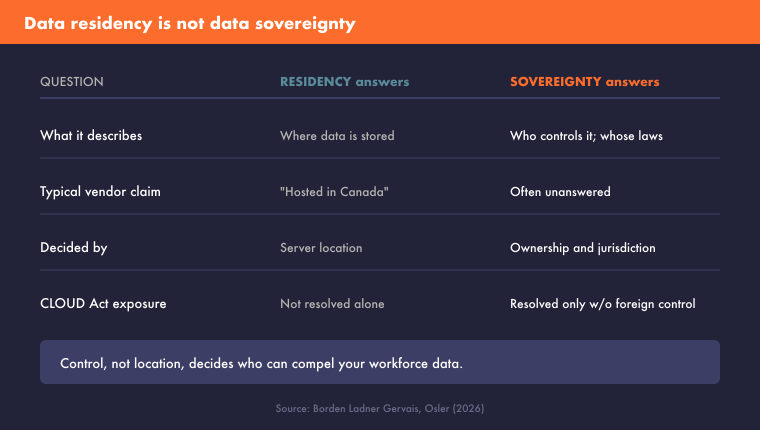
| Question | Data residency answers | Data sovereignty answers |
|---|---|---|
| What it describes | Where the data is physically stored | Who controls the data and whose laws apply |
| Typical vendor claim | "Hosted in a Canadian data center" | Often unanswered |
| Decided by | Server location | Corporate ownership and legal jurisdiction |
| CLOUD Act exposure | Not resolved by residency alone | Resolved only if no foreign entity controls the data |
Why does data sovereignty matter most for public-sector workforce data?
It matters most here because of what a workforce management system holds. A public-sector WFM platform is not a calendar. It holds collective bargaining agreement (CBA) terms, seniority lists, grievance history, banked time, health-driven absence records, and the schedules of thousands of people. That is labour-relations data and privacy data in one database. A foreign legal request reaching into it is a union problem and a privacy problem at the same time.
Quebec's Law 25 makes the obligation concrete. Before personal information leaves the province, the public body must run a privacy impact assessment confirming the receiving jurisdiction offers protection comparable to Quebec's. If the vendor's parent is foreign, that assessment has to deal honestly with the chance of compelled foreign access.
The procurement side moved too. Canada's Buy Canadian Procurement Policy, in force since December 16, 2025, names digital sovereignty a priority and lists information and communications technology as a strategic sector. The supplier-preference threshold dropped from $25 million to $5 million on June 15, 2026, which pulls far more contracts into scope. Here is the catch. The policy does not require a vendor to disclose its parent company's jurisdiction. The Government of Canada defines digital sovereignty as autonomy over its digital infrastructure, data, and intellectual property. The procurement form still will not ask the sovereignty question for you. You have to ask it.
The five questions on a WFM vendor's data sovereignty passport
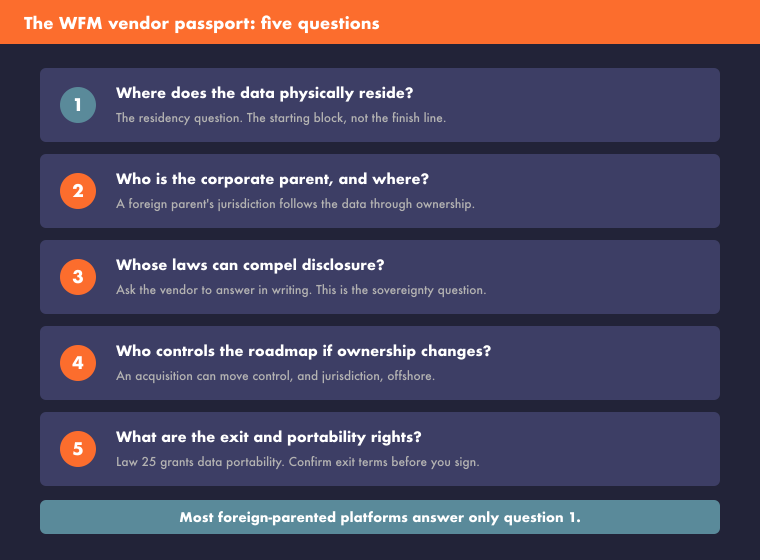
The vendor passport is a five-question framework. It places any WFM platform into one of three tiers: Canadian-owned, foreign-parented with localized residency, or foreign-parented with full extraterritorial exposure. The tiers come from van Es's April 2026 analysis. The questions turn them into a procurement check you can run every time. Most foreign-parented platforms answer only the first question.
Residency is the photo on the first page of the passport. The rest of the document is what tells you where the vendor belongs and whose rules govern it.
- Where does the data physically reside? This is the residency question, and most vendors answer it well. A Canadian data center is the expected starting point, not the whole interview.
- Who is the corporate parent, and under which jurisdiction? A platform with a Canadian office can still be a subsidiary of a foreign parent, and that parent's jurisdiction follows the data through the ownership chain.
- Whose laws can compel disclosure? Legal reach is set by control, not location. Ask the vendor to state in writing which governments could lawfully compel production of your workforce data.
- Who controls the product roadmap, and can a change of ownership move it offshore? The WFM market has seen a run of acquisitions and private-equity buyouts since 2024. Each one moves roadmap control, and sometimes legal jurisdiction, to a new owner.
- What are the exit, portability, and data-return rights? Law 25 grants a right to data portability, so your contract has to honor the organizational equivalent. Confirm the exit terms before you sign, not during a dispute.
Run those five and the tiers sort themselves. When a vendor answers question one cleanly and goes quiet on questions two and three, that silence is the finding. It belongs in your privacy impact assessment and your procurement file.
WorkAxle is Canadian-owned and built to answer all five of these questions by design. See how it's built →
What a clean sovereignty passport looks like
A clean passport means the vendor answers all five questions, starting with a corporate structure that points to a single jurisdiction. WorkAxle is a compliance-first enterprise workforce management platform, purpose-built for regulated organizations with multi-jurisdiction, multi-union workforces. I built it in Montreal, and we kept it Canadian-owned and Canadian-headquartered on purpose. Corporate structure answers "whose laws can compel this data" before any contract clause does, and ours points to one jurisdiction instead of two.
The rest of the passport follows from the same choices: in-country deployment, a configurable compliance engine that handles multi-jurisdiction and multi-union rules without custom scripting, and data portability built in rather than bolted on. We are a certified partner available on the SAP Store, which matters to public-sector stacks that have to integrate cleanly.
The proof that this holds outside a slide deck is Loto-Québec, a Quebec Crown corporation. It runs a complex, unionized gaming-sector workforce on WorkAxle's no-code rule builder, in both official languages, across scheduling, time and attendance, and demand forecasting. It evaluated the major incumbent platforms and chose WorkAxle. For a Crown corporation, the sovereignty answer was structural, not a feature comparison.
What should Canadian public-sector buyers do next?
Run the five-question passport before your next WFM evaluation or renewal. Residency is question one of five. If a vendor can answer only one, write that down. It is a legitimate finding for your Law 25 assessment and your Buy Canadian file, and it is far cheaper to surface now than during an audit or a foreign data request later.
WorkAxle was built to answer all five, and the Loto-Québec deployment shows it holds in a real Crown-corporation environment.
Frequently Asked Questions
Does storing data in Canada protect it from the US CLOUD Act?
Not on its own. Storing data in Canada does not stop foreign-law access when the company controlling that data is US-incorporated or a foreign subsidiary under US control. According to Borden Ladner Gervais, who controls the data matters more than where it sits, and the CLOUD Act can compel a covered company to produce data regardless of its physical storage location.
What is the difference between data residency and data sovereignty?
Data residency describes where data is physically stored. Data sovereignty describes who controls the data and whose laws can compel its disclosure. A vendor can offer Canadian data residency and still sit under foreign jurisdiction through its corporate parent. Residency is a necessary control, but sovereignty is the one that decides who can lawfully reach your workforce data.
What does Quebec's Law 25 require for transferring employee data outside Quebec?
Law 25 requires a privacy impact assessment before personal information is transferred outside the province. That assessment must confirm the receiving jurisdiction offers protection comparable to Quebec's, and it must result in a written agreement that addresses the identified risks. For public bodies handling unionized workforce data, the assessment should account for the chance of compelled foreign access.
Does the Buy Canadian policy require vendors to disclose their parent company's jurisdiction?
No. The Buy Canadian Procurement Policy, in force since December 16, 2025, names digital sovereignty a priority and applies a Canadian-supplier preference, but it does not require a vendor to disclose its parent company's jurisdiction. Buyers have to ask the sovereignty question themselves, which is why a structured vendor checklist matters during evaluation.
How do I evaluate a WFM vendor's data sovereignty?
Use a five-question vendor passport: where the data resides, who the corporate parent is, whose laws can compel disclosure, who controls the roadmap, and what the exit and portability rights are. Residency is only the first question. A vendor that answers all five, starting with Canadian ownership, sits in the strongest sovereignty tier for public-sector procurement.