

Last updated: May 2026
SAP SuccessFactors now has a native workforce scheduling module — but it only covers manufacturing and production. For enterprises with complex, regulated workforces, SAP workforce management for scheduling still depends on specialist partners. Here's how to evaluate all five options — SAP's native module and four specialist partners — after Sapphire 2026.
In this post:
SAP Sapphire 2026 (May 11-13, Orlando) was dominated by the Autonomous Enterprise vision: Joule AI agents, thirteen new HR assistants, and AI-orchestrated business processes. Buried in the product innovation guide was a quieter announcement that matters more to anyone navigating the vendor transition landscape: SAP SuccessFactors Workforce Scheduling.
That launch deserves attention. Not because of what it does, but because of what its scope reveals.
SuccessFactors Workforce Scheduling is built for manufacturing and production. If your scheduling challenges involve collective bargaining agreements (CBAs), multi-jurisdiction labor compliance, fatigue management, or 24/7 regulated operations, SAP's native module wasn't built for you.
SAP knows this. That's why they maintain a four-partner scheduling ecosystem alongside it.
What Did SAP Actually Announce for Workforce Scheduling?
SAP SuccessFactors Workforce Scheduling entered early adopter availability in January 2026, with general availability planned for later in 2026. SAP's own framing is explicit: the product helps "manufacturing and other production industries optimize shift planning with demand-driven, skills-based, and compliant scheduling."
The capabilities are real. The module supports demand-based scheduling, skills matching, real-time absence coverage, and mobile self-service. It integrates natively with SuccessFactors Time Tracking, Employee Central Payroll, and SAP Digital Manufacturing — a clean data flow from schedule to timecard to pay.
For a manufacturing operation with standard shift patterns, this is a meaningful addition to the SAP stack.
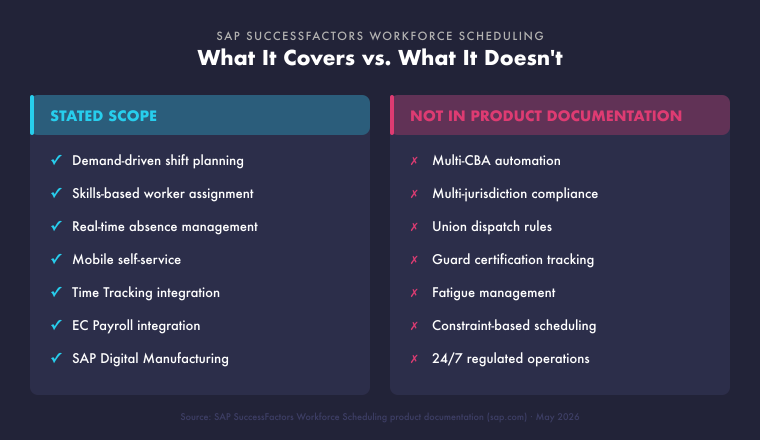
But read the product documentation carefully. You won't find references to multi-CBA automation, multi-jurisdiction compliance engines, union dispatch rules, guard certification tracking, or fatigue management. You won't find the kind of constraint-based scheduling that defines regulated industries like security, aviation, healthcare, and public sector operations.
Those capabilities aren't missing by accident. They're outside the product's stated scope.
What Are the Five SAP Workforce Scheduling Options in 2026?
SAP's native module is one of five scheduling paths available to enterprises running SAP today. The existence of the other four tells its own story.
| Option | What It Covers | Best Fit | What to Watch |
|---|---|---|---|
| SAP Native (SuccessFactors Workforce Scheduling) | Demand-driven, skills-based scheduling. Integrated with Time Tracking, EC Payroll, and Digital Manufacturing. | Manufacturing and production with standard shift patterns. | General availability still pending. Manufacturing scope only. No complex compliance automation. |
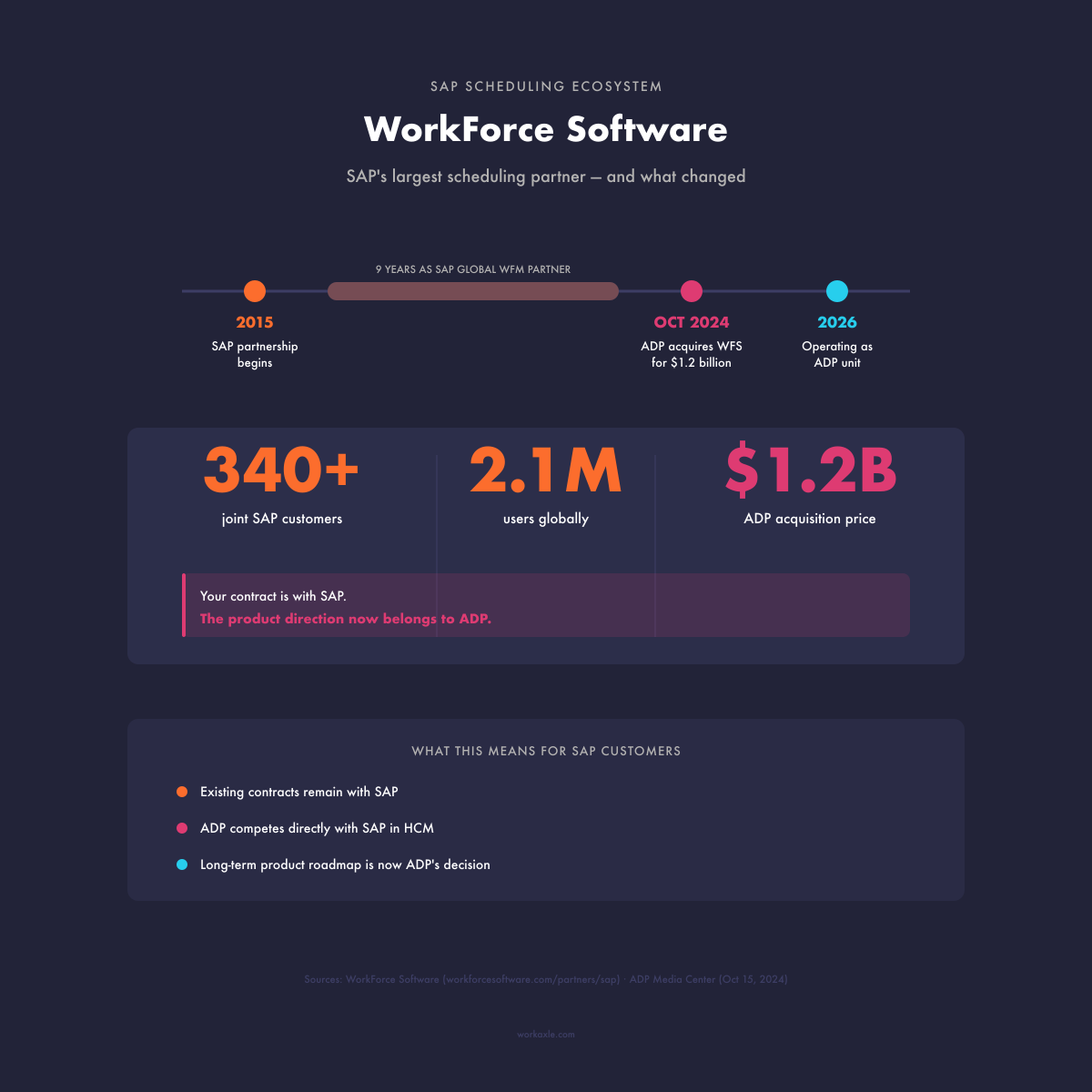
| WorkForce Software (SAP Solution Extension) | Full-scope WFM: time, attendance, scheduling, absence, forecasting. SAP's scheduling partner since 2015. 340+ joint SAP customers. 2.1 million users. Resold under SAP contract. | Large enterprises already invested in the SAP-WFS ecosystem. | Acquired by ADP in October 2024 for $1.2 billion. ADP competes directly with SAP in HCM. WFS continues operating as an ADP unit. |
| Legion (SAP Endorsed App) | AI-driven demand forecasting, automated scheduling, gig-style shift flexibility. Modern mobile UX. Endorsed since January 2025. | Retail, hospitality, and high-turnover hourly workforces where demand forecasting is the primary challenge. | Retail-focused product heritage. AI scheduling model is less configurable than rule-based approaches. Newer to enterprise multi-CBA environments. |
| ATOSS (SAP Endorsed App — Europe) | Time and attendance, scheduling, forecasting, capacity planning. The only SAP Endorsed App for workforce management in Europe. SAP Premium Certification (invitation-only). | European enterprises, particularly in the DACH region. | Strong European presence. Limited footprint in North America, APAC, and Latin America. |
| WorkAxle (SAP Store) | Compliance-first WFM: multi-jurisdiction scheduling, multi-CBA automation, demand forecasting, time capture, payroll preparation. Listed on the SAP Store. Integrates with SuccessFactors Employee Central and EC Payroll. | Complex, regulated workforces — security, aviation, healthcare, public sector, multi-union environments. | Smaller footprint than WFS or SAP native. Evaluate on compliance depth at your scale, vertical references, and deployment speed. |
Why Does SAP Rely on Partners for Complex Scheduling?
The Sapphire keynote made SAP's strategic direction clear. Constellation Research analyst Holger Mueller called it "the first time on this side of the millennium that SAP has a vision for ERP." That vision is the Autonomous Enterprise — AI agents orchestrating business processes end-to-end. It's not about becoming a scheduling vendor.
This tracks with a broader shift in enterprise architecture. Research from the Sapient Insights Group describes a trend among some organizations toward what they call "HR Platform Clusters" — two to four specialized platforms that integrate tightly but serve fundamentally different functions.
The logic is straightforward. An HCM suite like SuccessFactors owns the employee record: hire-to-retire data, compensation, learning, talent. An operational workforce management platform owns the daily complexity: scheduling against demand, enforcing CBA rules across jurisdictions, tracking certifications in real time, preparing payroll from validated time data.
These are different engineering problems. A platform optimized for employee lifecycle management isn't built to resolve which guard is certified for which post across multiple collective bargaining agreements with different overtime rules.
That's not a feature request. It's a different product category.
The same dynamic exists in the Workday ecosystem, where specialist scheduling partners fill the same architectural role. It's not an SAP-specific pattern. It's how complex enterprise integration architectures work.
How Should You Evaluate Your SAP Scheduling Architecture?
The right scheduling path depends on your workforce complexity, not on your SAP investment. Here's a decision framework:
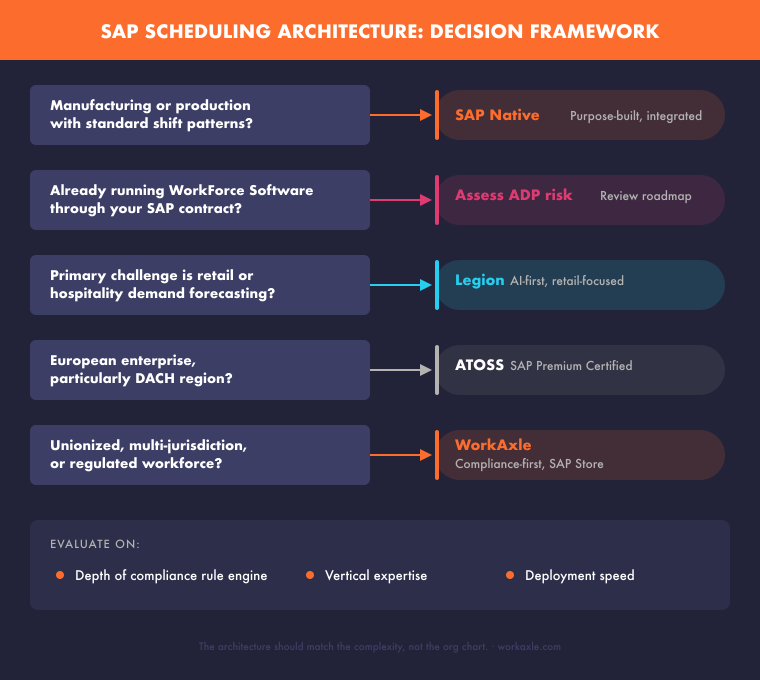
- Manufacturing and production with standard shift patterns? Evaluate SAP native. It's purpose-built for your environment and natively integrated.
- Already running WorkForce Software through your SAP contract? Assess your risk tolerance. Your contract is with SAP, but the product direction now belongs to ADP. No immediate action is required — WFS continues operating — but the long-term roadmap is worth understanding before your next renewal.
- Primary challenge is retail or hospitality demand forecasting? Legion's AI-first approach is built for high-volume, high-turnover environments where predicting demand is the hardest part of scheduling.
- European enterprise, particularly DACH region? ATOSS has the deepest SAP integration footprint in Europe, backed by SAP's invitation-only Premium Certification.
- Unionized, multi-jurisdiction, or regulated workforce? You need a compliance-first operational layer. WorkAxle, for example, automates overlapping CBAs in a single deployment and is purpose-built for regulated industries like security, aviation, and healthcare. Evaluate on three criteria: depth of the compliance rule engine, experience in your specific vertical, and deployment speed with references at your scale.
The architecture should match the complexity, not the org chart.
What Does This Mean for Your Post-Sapphire Planning?
SAP's native scheduling launch is a positive signal. It means SAP takes workforce scheduling seriously enough to build a product for it.
It also confirms what the partner ecosystem has demonstrated for years: scheduling is deep enough — and varied enough — to require specialized solutions for complex workforces.
The post-Sapphire question isn't "does SAP do scheduling now?" It's "which scheduling architecture fits our workforce complexity?"
The five-path framework above is a starting point. The answer depends on your industry, your labor agreements, your jurisdictions, and how much operational compliance you need automated versus managed manually.
WorkAxle is a compliance-first enterprise workforce management platform, available on the SAP Store. Purpose-built for regulated organizations with multi-jurisdiction, multi-union workforces.
Frequently Asked Questions
Does SAP SuccessFactors have native workforce scheduling?
Yes. SAP launched SuccessFactors Workforce Scheduling in early 2026, with general availability planned for later in the year. The module covers demand-driven, skills-based scheduling for manufacturing and production environments. It integrates with SuccessFactors Time Tracking, Employee Central Payroll, and SAP Digital Manufacturing. It does not cover multi-CBA automation, union dispatch, or the constraint-based scheduling required by regulated industries like security, aviation, and healthcare.
What workforce management partners work with SAP for scheduling?
Four major scheduling partners work alongside SAP's native module: WorkForce Software (SAP Solution Extension since 2015, 340+ joint customers), Legion (SAP Endorsed App since January 2025, retail-focused), ATOSS (the only SAP Endorsed WFM App in Europe, with Premium Certification), and WorkAxle, available on the SAP Store, purpose-built for compliance-heavy, multi-CBA, multi-jurisdiction environments.
What happened to WorkForce Software after the ADP acquisition?
ADP acquired WorkForce Software in October 2024 for approximately $1.2 billion. WorkForce Software continues operating as a unit of ADP. ADP competes directly with SAP in the HCM market, which creates a strategic consideration for enterprises running WFS through their SAP contract. Existing contracts remain with SAP, but long-term product direction is now under ADP.
Can SAP SuccessFactors handle union scheduling and multi-CBA compliance?
SAP SuccessFactors Workforce Scheduling does not currently address multi-CBA automation, multi-jurisdiction compliance engines, or union dispatch rules. Its stated scope is manufacturing and production scheduling. Enterprises with union environments, collective bargaining agreements, or regulated compliance requirements typically use one of SAP's specialist scheduling partners to handle those operational complexities.
What is SAP SuccessFactors Workforce Scheduling designed for?
SAP SuccessFactors Workforce Scheduling is designed for manufacturing and production industries. It supports demand-driven shift planning, skills-based worker assignment, real-time absence management, and mobile self-service. The module integrates with SAP Digital Manufacturing for production-aligned scheduling. It is not designed for industries requiring fatigue management, guard certification tracking, or complex labor compliance across multiple jurisdictions.
If your SAP scheduling architecture involves unions, multiple jurisdictions, or regulated compliance, a 30-minute assessment can map your current scheduling gaps, identify which of the five paths fits your workforce complexity, and outline a realistic evaluation timeline — your systems, your CBAs, your stack.