
Last updated: May 2026
I have spent the better part of fifteen years inside enterprise WFM — implementing legacy platforms, watching customizations spiral into spaghetti, and sitting across the table from operations leaders who know their system is failing but cannot rip it out without risking payroll. I have never seen the market shift this fast.
Three forces are converging at once: end-of-life deadlines, billion-dollar acquisitions, and shrinking vendor capacity. If your vendor is mid-transition, the decisions you make in the next twelve months will define your operations for the next five.
If you run complex operations — multi-site, unionized, regulated — your WFM platform is not optional infrastructure. It is the operational layer between your people and your payroll, meaning it is how schedules become hours, hours become compliance checks, and compliance checks become correct paychecks.
When that layer is stable, nobody thinks about it. When it is not, everybody feels it.
Right now, a lot of workforce management platforms are not stable. And if you are a Kronos Workforce Central customer facing the WFC end-of-life deadline, you already know this.
In this post:
What Is Actually Happening in the WFM Market in 2026
The workforce management industry is going through a consolidation cycle that happens maybe once a decade. Three things are converging at the same time, and each one affects your planning horizon.
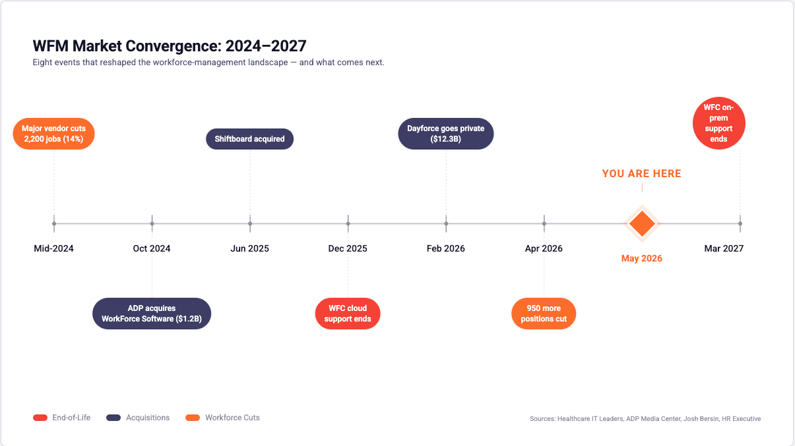
First, Kronos WFC is reaching end of life. Cloud support ended December 31, 2025. On-premises support ends March 31, 2027.
If you are still running WFC, you are on a countdown — not to an upgrade, but to a reimplementation. Meaning your scheduling rules, your pay policies, your integrations — they do not carry over. You rebuild them. According to Healthcare IT Leaders, the transition takes anywhere from twelve weeks to twelve months or longer, depending on organizational readiness and complexity.
For complex organizations with multiple collective bargaining agreements (CBAs), custom compliance rules, and deep integrations, twelve months is the realistic floor — not the ceiling.
Kronos WFC end-of-life milestones:
- December 31, 2025 — Cloud hosting support ended
- March 31, 2027 — On-premises support ends
- 12 weeks to 12+ months — Migration timeline depending on complexity (Healthcare IT Leaders)
Second, the big vendors are acquiring and integrating. Every major WFM incumbent is mid-transition in 2026.
ADP acquired WorkForce Software for $1.2 billion in October 2024 and launched a unified suite thirteen months later.
Separately, Shiftboard was acquired, adding 500-plus organizations in oil and gas, energy, and manufacturing to another major platform. Constellation Research analyst Holger Mueller described that integration challenge plainly: “Now comes the hard work of consolidating scheduling engines.”
Dayforce went private under Thoma Bravo for $12.3 billion in February 2026.
Third, vendor capacity is contracting. Industry-wide restructuring has reduced headcount at major workforce management vendors significantly over the past eighteen months.
One major vendor cut over 2,200 employees — 14% of its workforce — in mid-2024, followed by additional rounds in late 2025 and early 2026, culminating in another 950 positions in April 2026. Cumulative reductions now exceed 3,100 jobs across four rounds. Development teams have shifted offshore.
The Sapient Insights 27th Annual HR Systems Survey found that 64% of organizations that gave poor vendor satisfaction ratings cited customer service as the primary driver. That is not a blip. That is a structural shift — meaning the people you are counting on to help you migrate are stretched thinner than they have ever been.
These three forces — end-of-life deadlines, acquisition integration, and reduced vendor capacity — are hitting at the same time. I have been in this industry long enough to know that any one of these would be disruptive on its own. All three together? That is a fundamentally different conversation.
Why WFM Vendor Consolidation Is Actually an Opportunity
Here is what I think gets missed in the noise: this kind of market disruption is rare, and it creates a genuine evaluation window. I have seen too many operations leaders treat vendor transitions as something to survive. It is not. It is something to use.
The Sapient Insights survey also found that 58% of HRIS and HRIT professionals have been in their current roles less than three years. Fresh decision-makers are running fresh evaluations. And the assumptions your organization made about workforce management five or ten years ago may not hold anymore — not because those decisions were wrong at the time, but because the landscape has shifted.
When your vendor is mid-acquisition, mid-integration, or mid-restructuring, you have more negotiating leverage than you will at any other point in the contract cycle. You also have a legitimate business reason to evaluate Kronos WFC alternatives as part of your due diligence.
I am tired of watching organizations get pushed into rushed migrations because they waited for the vendor to tell them when to move. Stop waiting. The ground is already shifting.
.png?width=795&height=447&name=Pull%20Quote%20%E2%80%94%20Stop%20Waiting%20(Print).png)
What a Modern WFM Migration Timeline Looks Like
Enterprise WFM migration does not have to be a twelve-to-twenty-four-month project. That assumption comes from legacy platforms where configurations are rigid, integrations are brittle, and compliance logic is hard-coded. When I was implementing large enterprise WFM platforms earlier in my career, this was just the reality — you pulled one thread and the whole thing unraveled. Like a magician’s handkerchief trick, except nobody was entertained.
With legacy architecture, every migration becomes a reimplementation. It does not have to be.
When one of North America's largest multinational security companies needed to move off their previous workforce management platform, they came to us with a hard deadline: be live in two months or lose the contract. Our team deployed across 45 airports, 13 collective bargaining agreements, and 7,500+ employees in that window. Not two years. Two months. The platform they displaced was the same one that just got acquired for $1.2 billion.
That timeline is possible because modern workforce management architecture is different. Instead of rebuilding compliance rules from scratch, you configure them. Instead of custom integrations that take months, you connect through modern APIs. Instead of open-heart surgery, the system lands quietly and just works.
I am not saying every deployment takes two months. Complexity varies. But the assumption that twelve months is the floor — that is a legacy assumption, not a technical requirement.
Interested in what a realistic migration timeline looks like for your organization? See how WorkAxle approaches enterprise WFM deployment →
What to Do If Your WFM Vendor Is in Transition
If your WFM vendor is going through a transition right now — and there is a reasonable chance they are — here is how I would think about it. Crawl, walk, run:
- Audit your contract. Know your termination clauses, data portability rights, and renewal timeline. Knowledge is leverage.
- Document your current state. Map your scheduling rules, compliance configurations, integrations, and customizations — meaning every pay policy, every overtime rule, every integration touchpoint. If you need to move, this is your blueprint.
- Run a parallel evaluation. You do not have to switch. You need to know your options and realistic timelines. That information alone changes the conversation with your current vendor.
- Benchmark the market. Support responsiveness, implementation timelines, deployment models. The Sapient Insights vendor satisfaction data shows customer service as the top complaint — some vendors are well above the average, and some are well below.
.png?width=795&height=447&name=If%20Your%20WFM%20Vendor%20Is%20in%20Transition%20%E2%80%94%20Checklist%20(Print).png)
The market will stabilize. It always does. The question is whether you use this window to make a deliberate choice — or whether you let the vendor’s timeline make the choice for you.
Frequently Asked Questions
How long does it take to migrate from Kronos WFC to a new WFM platform?
Migrating from Kronos Workforce Central takes anywhere from twelve weeks to twelve months or longer, depending on organizational readiness and complexity, according to Healthcare IT Leaders. For complex organizations with multiple collective bargaining agreements (CBAs), custom compliance rules, and deep integrations, twelve months is the realistic floor — not the ceiling.
What does WFM vendor consolidation in 2026 mean for customers?
Three forces are converging simultaneously: Kronos WFC end-of-life (on-prem support ends March 2027), billion-dollar acquisitions reshaping the vendor landscape, and significant workforce reductions at major vendors. The Sapient Insights Annual HR Systems Survey found that 64% of organizations giving poor vendor satisfaction ratings cited customer service as the primary driver. For customers, this means longer implementation timelines, reduced support capacity, and an urgent reason to evaluate alternatives.
What should I do if my WFM vendor gets acquired?
Start with four steps: audit your contract for termination clauses and data portability rights, document your current scheduling and compliance configurations, run a parallel evaluation to understand your options and realistic timelines, and benchmark vendors on support responsiveness and implementation speed. Vendor transitions create negotiating leverage — use the evaluation window before the market stabilizes.
Can enterprise WFM be deployed in less than twelve months?
Yes. The twelve-to-twenty-four-month timeline is a legacy-architecture assumption, not a technical requirement. Modern WFM platforms use configurable compliance engines and API-based integrations instead of hard-coded logic and custom builds. GardaWorld, a multinational security company, deployed enterprise workforce management across 45 airports, 13 collective bargaining agreements, and 7,500+ employees in a two-month window.
If you're still running Kronos Workforce Central, a 30-minute assessment can evaluate your migration complexity, identify what breaks during the move, and map a realistic timeline before on-prem support ends — no obligation, no generic pitch.