

Last updated: June 2026
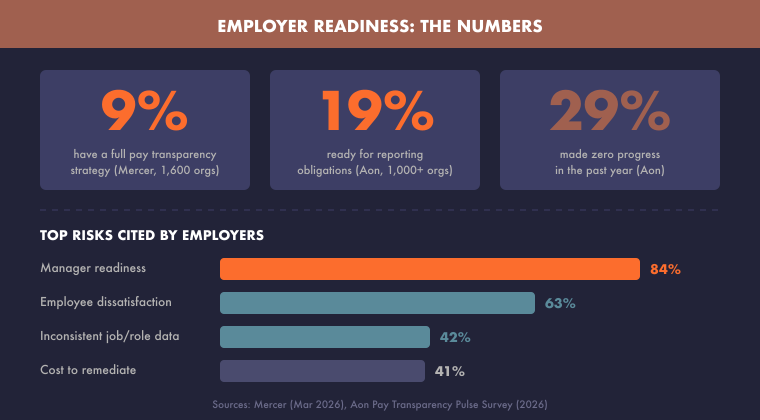
The EU Pay Transparency Directive (Directive 2023/970) requires EU member states to transpose its provisions into national law by June 7, 2026. As of late May 2026, only 2 of 27 member states — Slovakia and Italy — have passed comprehensive implementing legislation, according to L&E Global. A March 2026 Mercer survey of 1,600 organizations across 60 markets found that only 9% of European employers have a full pay transparency strategy in place.
Most compliance guidance focuses on salary ranges in job postings and HRIS configuration. But for any organization with shift-based, hourly, or union-represented workers, the compliance challenge extends into the workforce management platform — the system that generates the overtime, shift differential, and premium pay data the directive now requires employers to report by gender.
In this post:
What Does the EU Pay Transparency Directive Require from Employers?
The EU Pay Transparency Directive creates three layers of employer obligations with different timelines: immediate transparency rules effective from June 7, 2026, phased gender pay gap reporting starting in 2027, and enforcement mechanisms that shift the burden of proof to employers in pay discrimination cases.
Immediate obligations (effective June 7, 2026, in countries that have transposed — the process of writing EU directive requirements into national law):
| Requirement | What It Means |
|---|---|
| Salary ranges in job postings | Employers must share the initial pay level or pay range with candidates before the first interview — or in the posting itself |
| Ban on pay history questions | Employers cannot ask candidates about their current or previous compensation |
| Employee right to pay information | Any worker can request their individual pay level and the average pay levels, broken down by sex, for employees doing equal or equivalent work |
| Pay secrecy clauses void | Contractual clauses that prohibit employees from discussing their pay are unenforceable |
| Gender-neutral job evaluation | Criteria for defining “equal work” or “work of equal value” must be objective, gender-neutral, and shared with employees |
Reporting obligations (phased by employer size):
| Deadline | Who Reports | What |
|---|---|---|
| June 7, 2027 (based on 2026 data) | Employers with 250+ employees | Gender pay gap report covering base pay AND complementary/variable pay components, broken down by worker category. Reported annually. |
| June 7, 2027 (based on 2026 data) | Employers with 150-249 employees | Same report. Reported every three years. |
| June 7, 2031 | Employers with 100-149 employees | Same report. Every three years. |
The enforcement shift: If a gender pay gap exceeds 5% and cannot be justified by objective, gender-neutral criteria, a joint pay assessment with worker representatives becomes mandatory. The burden of proof in pay discrimination cases now falls on the employer. Workers who prevail can recover full back pay, bonuses, and payments in kind. Fines are tied to annual turnover.
Which EU Countries Have Transposed the Pay Transparency Directive?
As of May 20, 2026, only 2 of 27 EU member states have passed comprehensive transposition legislation, while 11 have no public draft at all. The European Commission has stated that no postponement of the June 7, 2026 deadline is possible, and at least 10 member states face potential infringement proceedings.
L&E Global reports the full breakdown: 2 states have completed legislation (Slovakia and Italy), 4 have partial measures in force, 10 have published draft legislation, and 11 have no public draft. (For a live, country-by-country tracker, see Syndio's EU transposition status tracker.)
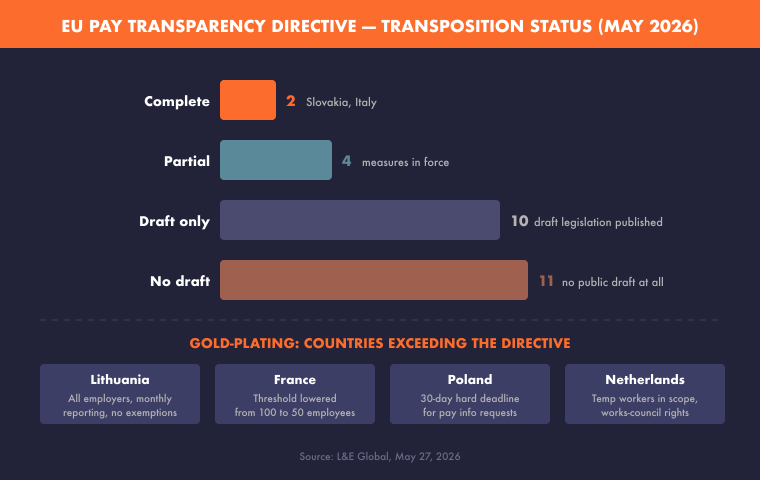
Several countries have explicitly pushed their timelines. The Netherlands, Czechia, and Denmark are all targeting January 1, 2027. Estonia's Economic Affairs Minister declared the country would rather pay a fine than meet the deadline. Sweden reversed course in March 2026, calling the directive “too administratively burdensome.”
The delay story obscures a harder problem. Countries that are transposing aren't doing it uniformly — they're gold-plating, meaning they are adding requirements that exceed the directive's baseline:
- Lithuania imposes obligations on all employers regardless of size, with monthly pay and working-time reporting. No exemptions.
- France lowers the reporting threshold from 100 employees to 50.
- Poland adds a 30-day hard deadline for responding to employee pay information requests.
- The Netherlands extends scope to temporary agency workers and strengthens works-council rights.
For a multi-country employer, the challenge is not one deadline but a matrix of different thresholds, reporting formats, and enforcement timelines — all layered on top of the directive's baseline requirements.
Why Are 91% of European Employers Unprepared for Pay Transparency?
Multiple 2026 surveys converge on the same conclusion: the vast majority of European employers lack the data infrastructure, pay structures, and manager readiness to comply with the directive's requirements, and progress has stalled for nearly a third of organizations.
Aon's 2026 Pay Transparency Pulse Survey, which polled more than 1,000 organizations, found that only 19% report being ready for reporting obligations. Manager readiness is the top concern — 84% of respondents flagged it as their biggest risk, followed by employee dissatisfaction (63%) and cost to remediate gaps (41%).
Twenty-nine percent of organizations have made no significant progress in the past year. Forty-two percent cite inconsistent job or role data as a primary challenge, meaning the pay information they would need to report is scattered across systems that were not built to produce comparable, gender-disaggregated compensation data. Only 26% have conducted an independent pay gap analysis in the past 18 months. Twelve percent have never performed one at all.
Of those who did analyze their pay data, 84% found disparities, according to a separate Aon survey of 626 US employers. As Brooke Green, head of North American talent solutions at Aon, put it: “Companies say they're a little behind, and the reality is, they're a lot behind.”
84% of employers who analyzed their pay data found disparities. The other 74% haven't looked yet. The directive will look for them.
— Aon, 2024
But every one of these surveys measures readiness against compensation strategy, pay structures, and HRIS capabilities. None ask about the system that generates much of the pay data in the first place.
How Does Pay Transparency Affect Workforce Scheduling and WFM Systems?
The EU Pay Transparency Directive requires employers to report gender pay gaps in “complementary or variable components” of compensation — not just base pay. For any organization with shift-based or hourly workers, those variable components include overtime pay, shift differentials (premium pay for non-standard hours like nights, weekends, and holidays), and premium assignments. Every one of those figures originates in the workforce management layer, making scheduling systems a critical but overlooked compliance dependency.
Here is the data pipeline most compliance teams are not auditing:
Scheduling → Time & Attendance → Time Classification → Payroll → Pay Gap Report
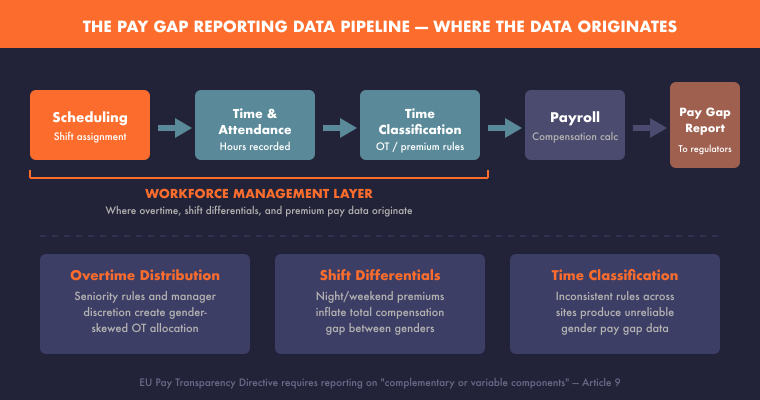
Time classification is the process by which hours worked are categorized as regular, overtime, premium, or on-call — directly determining what appears in payroll and, by extension, in the gender pay gap report. If any link in this chain is broken, inconsistent, or incapable of segmenting data by gender, the pay gap report that reaches regulators is either incomplete or indefensible.
Overtime distribution creates reportable pay gaps. How extra hours get allocated across a workforce is rarely gender-neutral in practice. Seniority rules, manager discretion, and availability patterns all shape who gets overtime. In industries like security, manufacturing, and healthcare, these patterns often skew male. Under the directive, that overtime skew becomes a reportable gender pay gap — even if the base hourly rate is identical for men and women doing the same work.
Shift differentials inflate total compensation gaps. Night shift, weekend, and holiday premiums are compensation components under the directive. If men are disproportionately assigned premium-rate shifts — a pattern common in security operations and industrial settings — the differential creates a gender pay gap in total compensation even when base rates are equal. The schedule is not equal. The pay gap report reflects the schedule.
Inconsistent time classification produces unreliable reporting data. When classification rules vary across sites or jurisdictions, the data feeding payroll — and therefore pay gap reports — becomes unreliable. Under a directive that shifts the burden of proof to the employer, unreliable data is not just an operational problem but a legal exposure.
The question most workforce teams have not asked: can our scheduling system report overtime hours, shift differential assignments, and premium pay allocations disaggregated by gender? If the answer is no, the pay gap report has a gap that no HRIS audit will catch.
Is Pay Transparency Only an EU Issue?
Pay transparency is a global regulatory trend, not solely a European one. The OECD projects that by the end of 2026, 84% of its member countries — 32 of 38 — will mandate some form of private-sector gender pay gap reporting, with much of the expansion driven by the EU directive's transposition requirements.
In North America, 14 US states now require salary range disclosure in job postings — part of a broader wave of predictive scheduling laws now active across the US, covering an estimated 60 million workers — roughly half the US workforce. California's SB 642, effective January 2026, tightened the definition of “pay scale” to mean the actual expected compensation range. If a remote position can be performed from a state with transparency requirements, that state's law generally applies regardless of employer headquarters location.
For multi-jurisdiction employers managing workforces across EU member states, US states, and Canadian provinces, the challenge is structural: different rules, different thresholds, and different reporting formats all requiring the same underlying data.
What Should Workforce Teams Do to Prepare for Pay Transparency Compliance?
Whether your country has transposed or not, the data collection clock is already running because the 2027 reports draw on 2026 data. Here are six steps workforce teams should take — including the scheduling-layer audit that most compliance guides omit.
1. Audit your scheduling data, not just your compensation data. Can your workforce management system report overtime hours, shift differential pay, and premium assignments disaggregated by gender? If not, that gap will not be caught by any HRIS-focused remediation effort.
2. Map the directive's “variable pay components” to your time classification rules. Overtime, shift differentials, bonuses — identify which originate in your scheduling and time system versus your compensation system. For shift-based workforces, the answer is most of them.
3. Review overtime and shift assignment patterns for gender correlation. Run the analysis before the directive requires it. If seniority rules, availability settings, or manager discretion are creating gender-skewed overtime distribution, find it now rather than in your first mandatory pay gap report.
4. Prepare for employee pay information requests. In transposed states, any employee can request their pay level and the gender-disaggregated average for equivalent roles starting June 7, 2026. Your system needs to produce this data on demand.
5. Track the transposition patchwork across your jurisdictions. If you operate across multiple EU member states, each may have different thresholds, timelines, and reporting formats. The directive's baseline is the floor, not the ceiling.
6. Don't wait for full national transposition. Every major law firm advising on this directive recommends the same approach: prepare based on the directive's minimum requirements, then adapt to national variations as they materialize.
This is where the system you use for scheduling and time classification matters. I built WorkAxle as a compliance-first workforce management platform for exactly this kind of multi-jurisdiction, multi-rule complexity. Our configurable rule engine codifies labor laws, union agreements, overtime thresholds, and shift differential rules directly into the scheduling logic — and enforces them before the schedule is published, not after. When a new jurisdiction adds requirements, it is a configuration change, not a development project.
Every scheduling decision, override, and assignment is logged with a full audit trail — timestamp, actor, and event context. That audit trail is the evidence layer the directive's enforcement mechanisms now demand. We currently serve 22+ enterprise customers across five jurisdictions, with deployments that automate 18+ collective bargaining agreements in a single instance — each with different overtime distribution rules, seniority structures, and shift differential logic. The pay transparency directive is asking every employer in Europe to produce the kind of scheduling documentation these organizations already required: traceable, rule-driven, and defensible under audit.
The Deadline Is One Date. The Data Requirement Is Permanent.
June 7, 2026 will pass. Some countries will be ready, and most will not. But the transposition deadline is the beginning of a permanent reporting obligation, not a one-time compliance event.
By June 7, 2027, employers with 150 or more workers must submit gender pay gap reports built from 2026 data — data being generated right now in every scheduling decision, every overtime assignment, and every shift differential applied. The organizations that treat pay transparency as a compensation project will discover the gaps originated upstream, in the scheduling and time systems that shape what people actually earn.
The ones that audit the full pipeline — from schedule to payroll to report — will be the ones that produce a number they can defend.
Frequently Asked Questions
What does the EU Pay Transparency Directive require from employers?
The EU Pay Transparency Directive (Directive 2023/970) requires employers to disclose salary ranges in job postings, prohibits asking candidates about pay history, and gives employees the right to request gender-disaggregated pay data for equivalent roles. Employers with 150 or more employees must submit gender pay gap reports starting in 2027, covering both base pay and variable compensation components like overtime and shift differentials. If the reported gap exceeds 5% without objective justification, a mandatory joint pay assessment with worker representatives is triggered.
Which EU countries have transposed the Pay Transparency Directive?
As of May 2026, only Slovakia and Italy have passed comprehensive transposition legislation out of 27 EU member states. Four additional countries have partial measures in force, 10 have published draft legislation, and 11 have no public draft at all. Several countries, including the Netherlands, Czechia, and Denmark, have pushed their target implementation date to January 1, 2027. The European Commission has confirmed that no postponement of the June 7, 2026 deadline is possible.
What are the penalties for non-compliance with EU pay transparency rules?
The directive shifts the burden of proof in pay discrimination cases to the employer — meaning the company must prove it did not violate equal pay rules, rather than the employee proving discrimination occurred. Workers who prevail can recover full back pay plus bonuses and payments in kind. Financial penalties must be “effective, proportionate and dissuasive” and may be calculated based on the employer's annual turnover, though specific amounts are set by individual member states during transposition.
What data do employers need for gender pay gap reporting under the directive?
The directive requires reporting on gender pay gaps in both base salary and “complementary or variable components” of compensation, broken down by worker category. For shift-based workforces, variable components include overtime pay, shift differentials, night and weekend premiums, and holiday pay — all of which originate in the workforce management and scheduling layer rather than in HRIS or compensation systems. Employers need their systems to segment this data by gender across every pay component.
Does the EU Pay Transparency Directive affect US companies?
The directive directly affects any US-headquartered company with 100 or more employees in EU member states, as reporting obligations apply based on EU headcount regardless of global headquarters location. Beyond direct applicability, the directive is part of a broader global trend: 14 US states already require salary range disclosure covering an estimated 60 million workers, and the OECD projects that 84% of its member countries will mandate private-sector pay gap reporting by the end of 2026.