

Last updated: June 2026
You can separate real AI in workforce management from a marketing label with four questions: can the system explain a decision, can you configure the rule behind it, can you audit the output, and is there a human override. These four tests turn an "AI-powered" claim into something you can demonstrate in a live demo. They also map directly to where employment-AI regulation is heading, which is why a CTO should apply them during evaluation or renewal now, not later.
Open three workforce management vendor homepages side by side and you will read the same three words: AI-powered, autonomous, agentic. The labels are interchangeable. The capabilities behind them are not, and nothing on the page tells you which is which. If you are a CTO comparing platforms, or defending a renewal, you are being asked to bet a core operational system on a word.
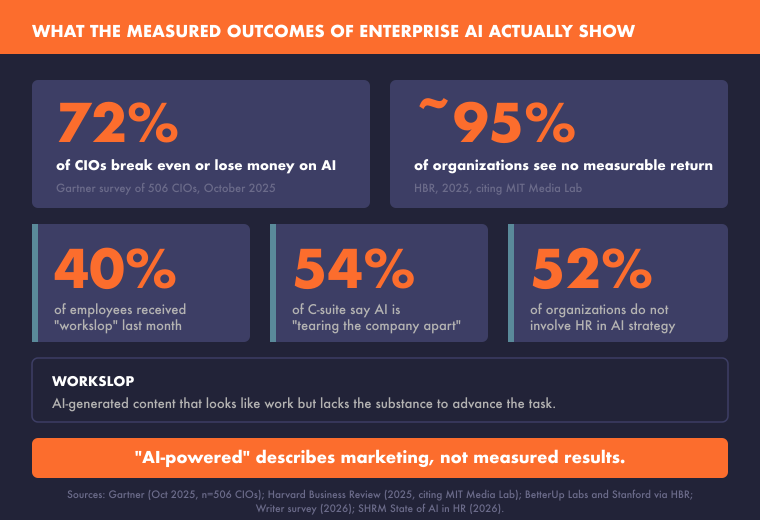
The gap between the marketing and the measured results is the whole reason these questions matter. In its October 2025 survey of 506 CIOs, Gartner found that 72% of CIOs report breaking even or losing money on AI. "AI-powered" describes marketing, not mechanics, and the four questions below cut through the label every time.
In this post:
- Why does every WFM vendor suddenly sound the same?
- What do the measured outcomes of enterprise AI actually show?
- What four questions separate real WFM AI from hype?
- Question 1: Can it explain why it made a decision?
- Question 2: Can you configure the rule it runs on?
- Question 3: Can you audit the output?
- Question 4: Is there a human override?
- Why are regulators about to make these four questions mandatory?
- How one operator put the rubric to work
- So what: take the rubric into your next vendor meeting
- Frequently asked questions
Why Does Every WFM Vendor Suddenly Sound the Same?
Every workforce management vendor sounds the same because the category has converged on one claim, autonomy, and markets it in nearly identical language. The words are interchangeable across homepages, but none of them tells a buyer whether a specific scheduling decision can be explained, configured, audited, or overridden. The label is shared. The substance underneath it is what you are actually buying.
Look at what the vendors say in their own words. Legion describes "autonomous workforce decision automation across forecasting, scheduling, time and attendance." UKG says its Bryte AI agents complete decision-making "autonomously." Quinyx calls itself "the market leader in AI-driven Workforce Management." Dayforce says its AI agents "aren't just automations, they're accelerators."
This is not a knock on any of them. The investment is real, the technology is advancing, and these are serious companies building seriously. The point is narrower: the label is the same, and the substance underneath it is the thing you are buying. The discipline here is the same one that separates a strong WFM purchase from a weak one, which is why it helps to ask hard evaluation questions before buying any workforce management solution, not just about AI.
What Do the Measured Outcomes of Enterprise AI Actually Show?
The measured outcomes of enterprise AI have been quiet. Beyond the 72% of CIOs breaking even or losing money, a 2025 Harvard Business Review article reported, citing MIT Media Lab research, that roughly 95% of organizations see no measurable return on their AI investment. That same article named the symptom and the strain it puts on the organization.
That symptom is "workslop," AI-generated content that looks like work but lacks the substance to be useful. In the HBR study, 40% of employees reported receiving workslop in the last month, which means the cost is not only a missing return but real time spent cleaning up output.
The strain shows up in the org chart, too. A 2026 Writer survey found 54% of C-suite leaders say adopting AI is "tearing their company apart," a finding echoed in trade coverage, and 79% of executives report facing AI adoption challenges. Part of the problem is who is at the table: SHRM found 52% of organizations do not involve HR in their AI strategy, even though workforce decisions land squarely on HR's desk.
If the label tells you nothing and the average outcome is underwhelming, you need your own way to read a vendor. That is what the next four questions give you.
Bring this rubric to your next vendor call.
The four tests below are written to be copied straight into your evaluation doc. Hand them to your buying committee and score every vendor against each one. If you would rather see them run against a live system, book a demo.
What Four Questions Separate Real WFM AI From Hype?
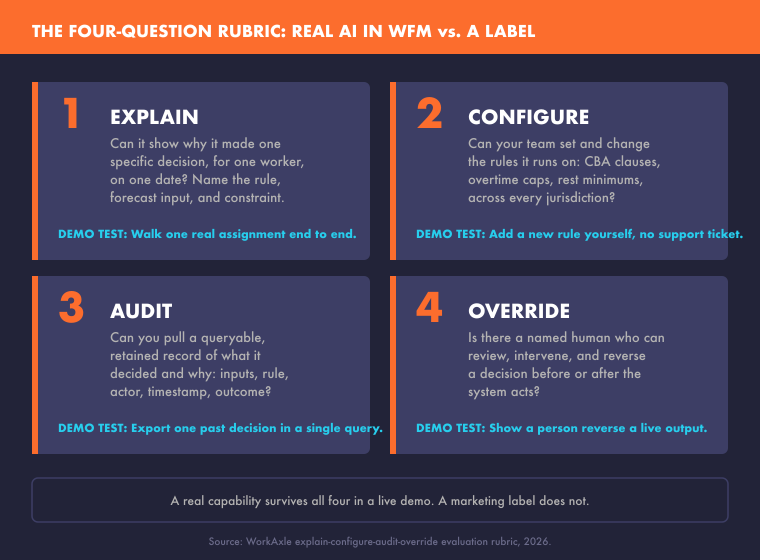
Four questions separate real AI in workforce management from hype: can it explain a decision, can you configure the rule it runs on, can you audit the output, and is there a human override. This explain-configure-audit-override rubric is vendor-agnostic, and each question turns a marketing claim into a capability you can see in a live demo rather than a word you have to trust.
It is not a contrarian framework. Independent 2026 buyer guidance converges on the same criteria, naming explainability, queryable audit logs, and human oversight as the things procurement should evaluate. These are also the same capabilities the EU is moving to require for employment AI, with high-risk obligations now set to apply from December 2, 2027. The four sections that follow take each question in turn.
Question 1: Can It Explain Why It Made a Decision?
A real AI in workforce management can show its reasoning for one specific decision about one specific worker on one specific date. This is local explainability: why this decision, for this worker, on this date. When the system schedules Maria for the Saturday night shift, it can name which rule, which forecast input, and which constraint produced that assignment. A label cannot answer that. A system built to be governed can.
This is not a niche academic property. Explainability and traceability are now named procurement criteria in 2026 buyer guidance, precisely because regulators are about to require them. Explainable AI scheduling is what makes the EU AI Act's worker-notice obligation possible, because you cannot tell a worker why a system affected them if the system cannot say why it decided what it decided.
In the demo, do not accept a confidence score or a heat map. Ask the vendor to take one real assignment and walk you through the chain that produced it. If the answer is "the model determined it," you have found the edge of the capability.
Question 2: Can You Configure the Rule It Runs On?
Real AI in workforce management lets you set and change the rules that govern its decisions yourself. A black box you cannot configure to your own union agreements and jurisdictional reality is a liability, not an asset. Workforce rules are not static: effective dating, overtime thresholds, rest-period minimums, and seniority logic change by law and by contract, and they differ across every jurisdiction you operate in.
Vendors sit on a spectrum here, and you can read it in their own marketing. Some lead with autonomy, like Legion's "autonomous workforce decision automation." At least one markets explicitly in the other direction: Paycor describes its scheduling AI as "human-in-the-loop," rules-constrained, with anomalies flagged for human review. Neither framing is automatically better. Your job is to locate each vendor on that spectrum and decide which end fits a workforce with real compliance exposure.
The practical test is ownership: can your team add a new CBA clause or a new jurisdiction's overtime cap yourselves, or does that change require a support ticket and a release cycle? This is where the rule logic behind employee scheduling and rostering earns or loses its keep. Buyer guidance is blunt about this, telling procurement to weigh configurability and integration over marketing claims. The vendor who controls your rules controls your compliance.
Question 3: Can You Audit the Output?
Real AI in workforce management produces a queryable, retained record of what it decided and why. If you cannot pull the log, you cannot prove compliance and you cannot defend a decision when someone challenges it. Auditability means every decision, the inputs and reasoning behind it, and the final output are captured in logs you can retrieve months later, not reconstructed from memory and spreadsheets.
This is the criterion regulators have converged on fastest. Audit trails and queryable logs now show up as a core procurement requirement. The EU AI Act specifically requires automatic logging, retained, for high-risk employment AI, which makes a queryable record a regulatory expectation rather than a nice-to-have.
The test is concrete. Ask the vendor to pull the full record for a single past decision: the inputs, the rule that fired, the actor, the timestamp, the outcome. This is also where time and attendance data has to reconcile with what the system scheduled, so the audit record is complete. If that is a one-query export, the system was built to be audited. If it takes a week and three teams to assemble, the audit capability is not really there.
Question 4: Is There a Human Override?
Real AI in workforce management keeps a named human able to step in, intervene, and reverse a decision. "Autonomous" without a meaningful override is exactly the gap regulators are closing. Override means a person on your team can review, intervene, and reverse before or after the system acts, so the decision is never delegated entirely to the machine.
This is not a philosophical preference anymore. The EU AI Act explicitly requires meaningful human oversight, including the ability to intervene and override outputs, for the high-risk employment systems it classifies under Annex III. A system that cannot be overridden cannot be compliant under that standard.
That is the full rubric: explain, configure, audit, override. Four questions you now own, each one demonstrable in a live decision, each one independent of whatever the homepage says. Which brings us to why regulators are converging on these same four questions.
"AI-powered" describes marketing, not mechanics. Explain, configure, audit, override describes what you are actually buying.
Why Are Regulators About to Make These Four Questions Mandatory?
Regulators are converging on these four questions because the EU AI Act treats workforce-management AI as high-risk and requires the exact capabilities the rubric tests. Under Annex III, point 4, employment and worker-management AI is classified as high-risk: systems that make decisions affecting work relationships, allocate tasks based on individual traits, or monitor and evaluate performance, along with recruitment and selection tools. That classification is settled.
The obligations are defined too. For high-risk employment AI they are meaningful human oversight and override, notice to workers and candidates, and automatic logging that is retained. The enforcement date moved: under the EU's Digital Omnibus, those high-risk obligations are now scheduled to apply from December 2, 2027 rather than the originally planned August 2026.
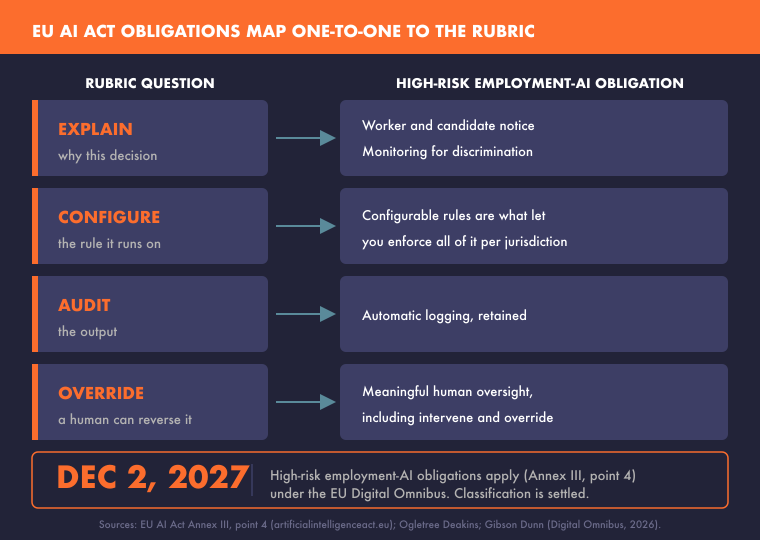
Map those obligations back to the rubric and they line up one to one. Human oversight is the override question. Logging is the audit question. Worker notice rests on explainability, the ability to say why a decision was made. Configurable rules are what let you enforce all of it across the jurisdictions you operate in. This is the direction the whole industry is moving: governability, the ability to audit and override, is becoming the buying criterion that matters more than raw model capability. The same pattern is showing up across EU workforce compliance regimes like the Pay Transparency Directive, where the data your scheduling system produces becomes evidence you have to stand behind. The classification is set and the obligations are defined. Your own exposure and timeline are yours to assess.
How One Operator Put the Rubric to Work
This is the problem I built WorkAxle to solve. WorkAxle is a compliance-first enterprise workforce management platform purpose-built for regulated organizations with multi-jurisdiction, multi-union workforces. When I started, the design choice was simple to state and hard to do well: every decision the system makes has to trace back to a rule you set, written in language you can read, that a person on your team can change or reverse. Not a model you have to trust. A rule you own.
That choice maps straight onto the four questions. A scheduling decision traces to a configurable rule, so it can be explained, and the rule can be changed by your team in a no-code builder, with no support ticket between you and your own compliance logic. Enforcement actions, overrides, and rule changes are recorded in a filterable audit log with the actor and the timestamp, so the audit trail is captured as you work rather than reconstructed afterward from memory and spreadsheets. And a human stays in control: you can test a rule change before it goes live, and when a shift would break a rule the system flags it for a person to resolve rather than forcing the call. Explain, configure, audit, override, by design.
A multi-state operator chose WorkAxle after evaluating the major AI-WFM platforms. These are the same four questions I built the platform to answer. I will say what I believe after years of building in this category: AI is a commodity. The compliance platform it runs on is not.
See the rubric run against a live system.
A live demo shows you one real scheduling decision explained end to end, a rule changed in the no-code builder, an audit record exported in a single query, and a human override in action, your four questions, demonstrated rather than described.
So What: Take the Rubric Into Your Next Vendor Meeting
Do not evaluate the AI label. Evaluate the four capabilities behind it. Can it explain a decision? Can you configure the rule? Can you audit the output? Is there a human override? Ask every vendor, including the one you already use, to demonstrate each one with a single live decision, end to end. A real capability survives that test. A label does not.
These are the questions a regulator is moving to ask on your behalf. So the rubric does double duty: it is how you buy well, and it is how you stay ahead of where compliance is heading. Walk into the next meeting with the four questions written down, and let the demos answer them.
Frequently Asked Questions
How do you tell real AI in workforce management from marketing hype?
You tell real AI in workforce management from hype with four demonstrable tests: explainability, configurability, auditability, and human override. Ask a vendor to explain one real scheduling decision, change a compliance rule without a support ticket, export the full audit record for a past decision, and show a named human who can reverse an output. A genuine capability survives all four in a live demo. A marketing label does not, because the label describes positioning rather than mechanics.
What is explainability in a WFM AI system?
Explainability is the system's ability to show why it made one specific decision for one specific worker on a specific date. A real WFM AI can name the rule, the forecast input, and the constraint that produced an assignment. This local explainability matters because the EU AI Act's worker-notice obligation depends on it. You cannot tell a worker why a system affected them if the system cannot say why it decided.
Does the EU AI Act regulate workforce management AI?
Yes. The EU AI Act classifies employment and worker-management AI as high-risk under Annex III, point 4, covering systems that affect work relationships, allocate tasks, or evaluate performance. High-risk obligations include human oversight, worker notice, and retained automatic logging. Under the EU's Digital Omnibus, those obligations are now scheduled to apply from December 2, 2027, so the classification is settled even though the enforcement timeline shifted.
Why does AI return so little measurable value for most organizations?
Most organizations see little return because deployed AI often produces output that looks finished but lacks substance, not because the technology cannot help. A 2025 Harvard Business Review article reported, citing MIT Media Lab research, that roughly 95% of organizations see no measurable return on AI, and Gartner found 72% of CIOs report breaking even or losing money. Capabilities you can explain, configure, audit, and override are how a buyer avoids paying for a label instead of a result.
What questions should I ask a WFM vendor about their AI in a demo?
Ask the vendor to demonstrate four things with one real decision rather than describe them. First, walk through the exact rule, forecast input, and constraint behind a single assignment. Second, add a new CBA clause or overtime cap yourself without a support ticket. Third, export the full record of a past decision in one query. Fourth, show a named human who can intervene and reverse an output. These map to the explainability, queryable logs, and human oversight that 2026 buyer guidance recommends evaluating.